How to Set Fitness Goals That Actually Stick: A Smarter Approach to New Year's Resolutions
New Year’s resolutions fail when goals are vague. Here is a smarter way to set fitness goals you can actually keep, and the habits that make them stick.
19 October 2025 · 4 min read
Updated 13 September 2026
Every January, millions of people join gyms, start diets, and set ambitious fitness goals. By February, most have already given up. The problem isn’t motivation — it’s approach. New Year’s resolutions fail because they’re vague intentions without a plan. Next Year’s resolutions are different.
New Year’s Resolutions vs Next Year’s Resolutions
A New Year’s resolution says “I want to get fit.” You write off December waiting for January 1st, then throw yourself into something unsustainable. A Next Year’s resolution asks “who do I want to be by this time next year?” and works backwards to build a realistic plan to get there.
The shift is subtle but powerful. Instead of picking random activities to try, you define a meaningful outcome and map the steps required to reach it. This is the difference between saying “I’ll start running” and “I want to complete a 10k in under 55 minutes by October.”
How to Set Fitness Goals That Actually Stick
The SMART framework is the simplest way to turn a vague wish into an actionable goal:
Specific. “Get fitter” means nothing measurable. “Be able to deadlift 100kg for 5 reps” or “touch my toes without bending my knees” gives you a clear target.
Measurable. Attach numbers to your goal. Distance, weight, time, reps — whatever metric fits. If you can’t measure it, you can’t track it.
Achievable. Ambitious is good. Impossible is demotivating. If you’ve never run before, a sub-20-minute 5k by March probably isn’t realistic. A sub-30-minute 5k by June might be.
Relevant. Your goal needs to matter to you personally. Training for a marathon because your colleague is doing one won’t sustain you through the hard sessions. Choose something you genuinely want.
Time-bound. Give yourself a deadline. “By next New Year” works perfectly, but setting intermediate milestones — a 3-month check-in, a 6-month check-in — keeps you accountable along the way.
Building Fitness Habits That Last
Goals give you direction. Habits get you there. The popular claim that habits form in 21 days is misleading — research from University College London found that it takes an average of 66 days for a new behaviour to become automatic, with significant variation between individuals (anywhere from 18 to 254 days).
The good news? The same research found that missing a single day doesn’t reset your progress. So if you skip a session or have an off day, don’t use it as an excuse to quit. Just pick up where you left off.
Here’s how to make your fitness habit stick:
Start smaller than you think. If your goal is to train 5 days a week, start with 2-3. Build consistency first, then increase frequency. Jumping straight to an intense schedule is how people burn out by week three.
Attach it to an existing routine. “I’ll go to the gym straight after work on Monday, Wednesday, and Friday” is more likely to stick than “I’ll go to the gym when I feel like it.” Linking your workout to something you already do creates a trigger.
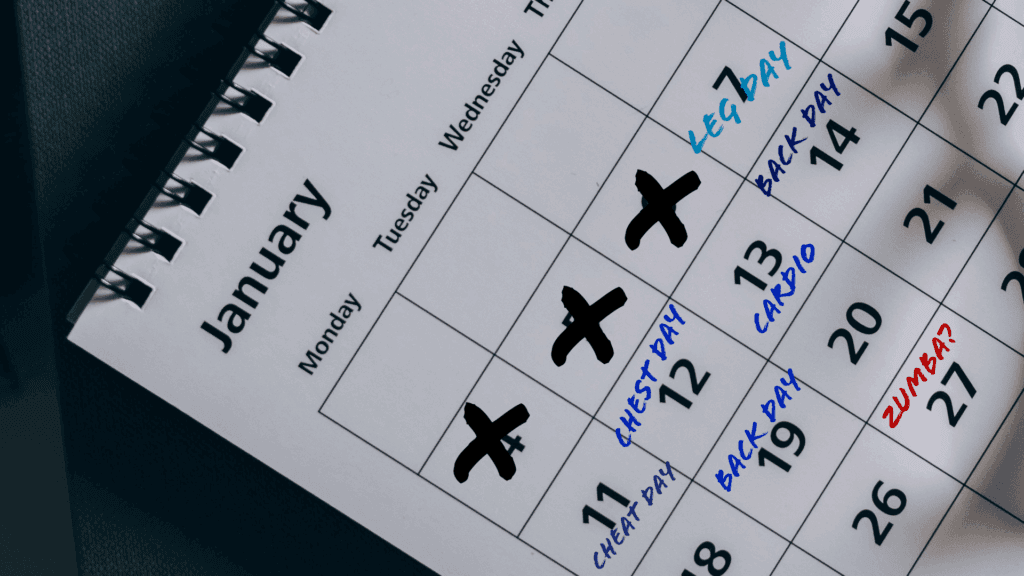
Track your progress. Use a training log, app, or even a simple calendar where you mark off each completed session. Seeing an unbroken chain of training days is surprisingly motivating.
Prepare for setbacks. You will miss sessions. You will have weeks where motivation dips. Plan for this in advance — have a shorter “minimum viable workout” that you can do on low-energy days, so you maintain the habit even when the intensity drops.
The January Rush and How to Survive It
If you’re joining a gym in January, expect it to be busy. The good news is that this usually settles down by mid-February. In the meantime, try training at off-peak hours, have a backup plan for when equipment is taken, and don’t let a crowded gym derail your new habit.
Better yet, start in December. Get a head start, learn the layout, and build your routine before the rush hits.
Start Planning Now
The best time to set your fitness goals isn’t January 1st — it’s right now. Decide what you want to achieve, break it into steps, and find the right environment to train in. Find a gym on Gymist that matches your goals and start building the future version of yourself.