The Social Fitness Survey 2026 - Part One
We asked 2,088 UK adults about their fitness, what encourages them, and what holds them back. Our survey questions were focused on the social elements of being active. Here's what our first survey found.
We are social creatures, and how we find our fitness is no exception. It shows up in how we feel exercising around other people, in how confident we are in one activity versus another, and whether we’re excited to recognise friendly faces in our happy place or feel like an outsider.
Our mission is to help everyone be active, whatever that means for each of us. Understanding how we think and feel about being active is a key part of that. It helps us understand that we aren’t the odd one out or an outlier. There are thousands of people who think and feel the same. It helps us understand why we avoid certain activities and how we can overcome avoidance.
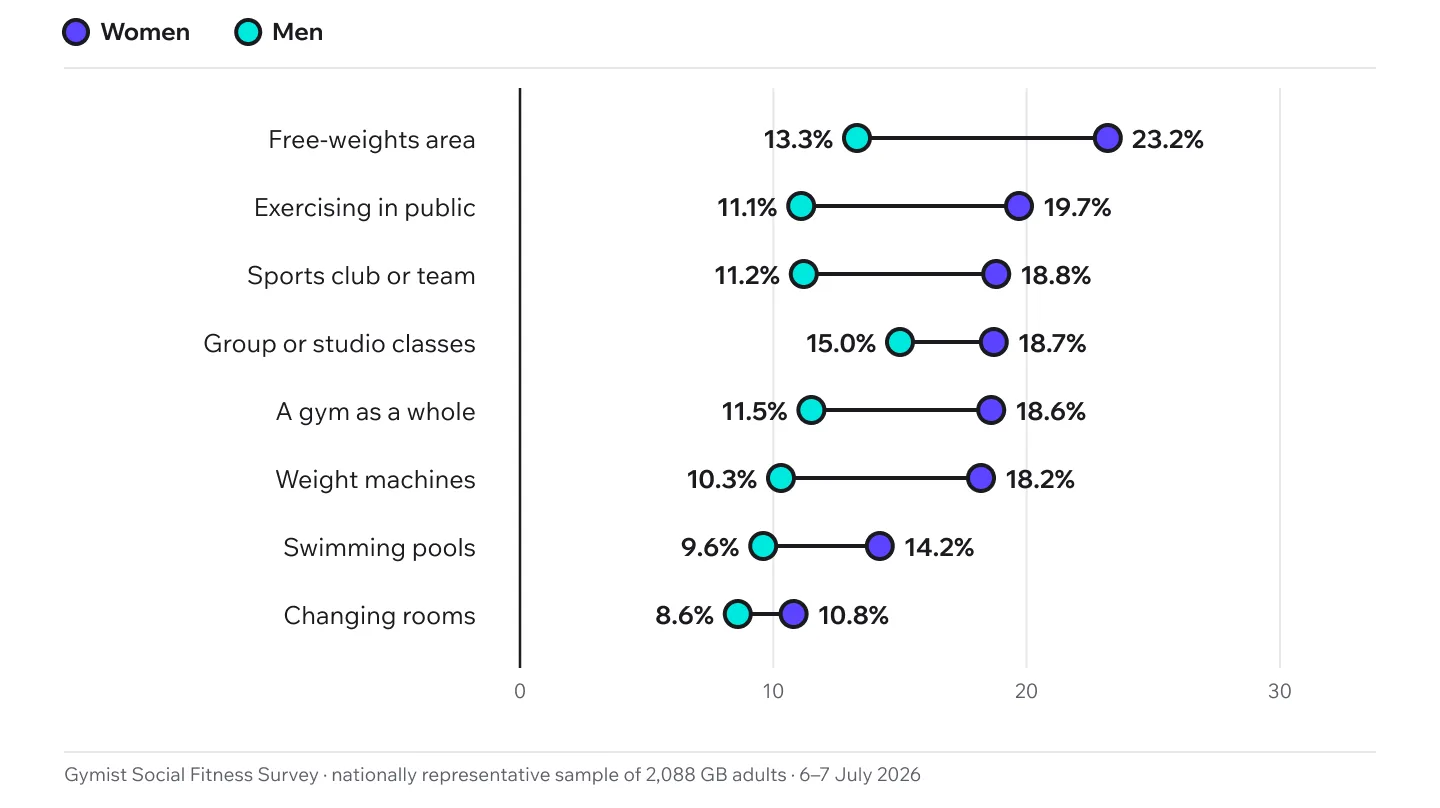
More women have avoided the free-weights area than use a studio, a sports club or a swimming pool combined — 23.2% against 17.0%.
So we commissioned a survey. Find Out Now polled 2,088 UK adults in July 2026 on where they exercise, how they exercise, and what they thought about different elements of active lifestyles they engaged with or avoided. The data is a nationally representative sample of regions, age groups, and gender.
Most importantly, the survey covers the whole range of activity; from those who are active more than three times a week to those who are completely inactive. We want to help those looking for the first steps into fitness as much as those who want to find a new Hyrox buddy.
What we do and where we do it
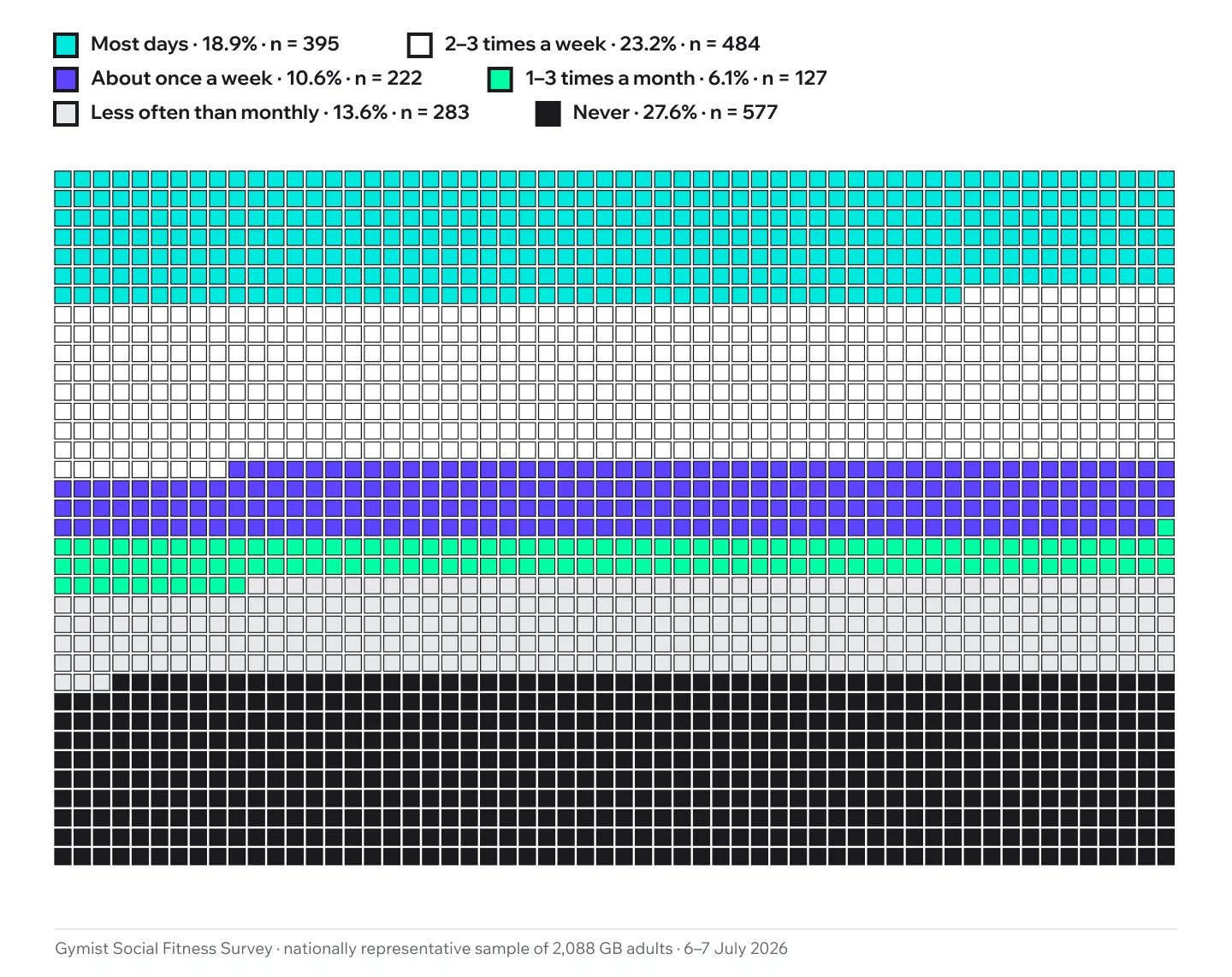
To better understand the social elements, we needed a baseline of where and how often are we active? First we asked: "How often do you do exercise or are intentionally physically active?", then "Where do you normally exercise?"
To put activity levels in perspective, the UK Chief Medical Officers recently updated activity guidance to recommend at least 150 minutes of moderate intensity activity a week, or 75 minutes of vigorous activity, plus muscle-strengthening work on at least two days.
Reference Physical activity guidelines: UK Chief Medical Officers' report GOV.UK 10 July 2026
We asked how often people exercise, but didn’t ask how long. We’ll change that in the 2027 survey. But we can say that two sessions a week is the measurement and from our survey 42% meet that level.
This is well below Sport England’s measure of 64.6% activity possibly due to our survey asking specifically about exercise or intentionally engage in physical activity which aligns to Sport England’s ‘fitness activities’. We didn’t exclude ‘active travel’ and ‘walking for leisure’ but labelled as a fitness survey, only 2.8% of respondents listed activities such as walking, work, and golf as their intentional activity. The next iteration will be explicit in surveying fitness activities.
Reference Active Lives Adult Survey November 2024-25 Report - Sport England
We’re either active or inactive
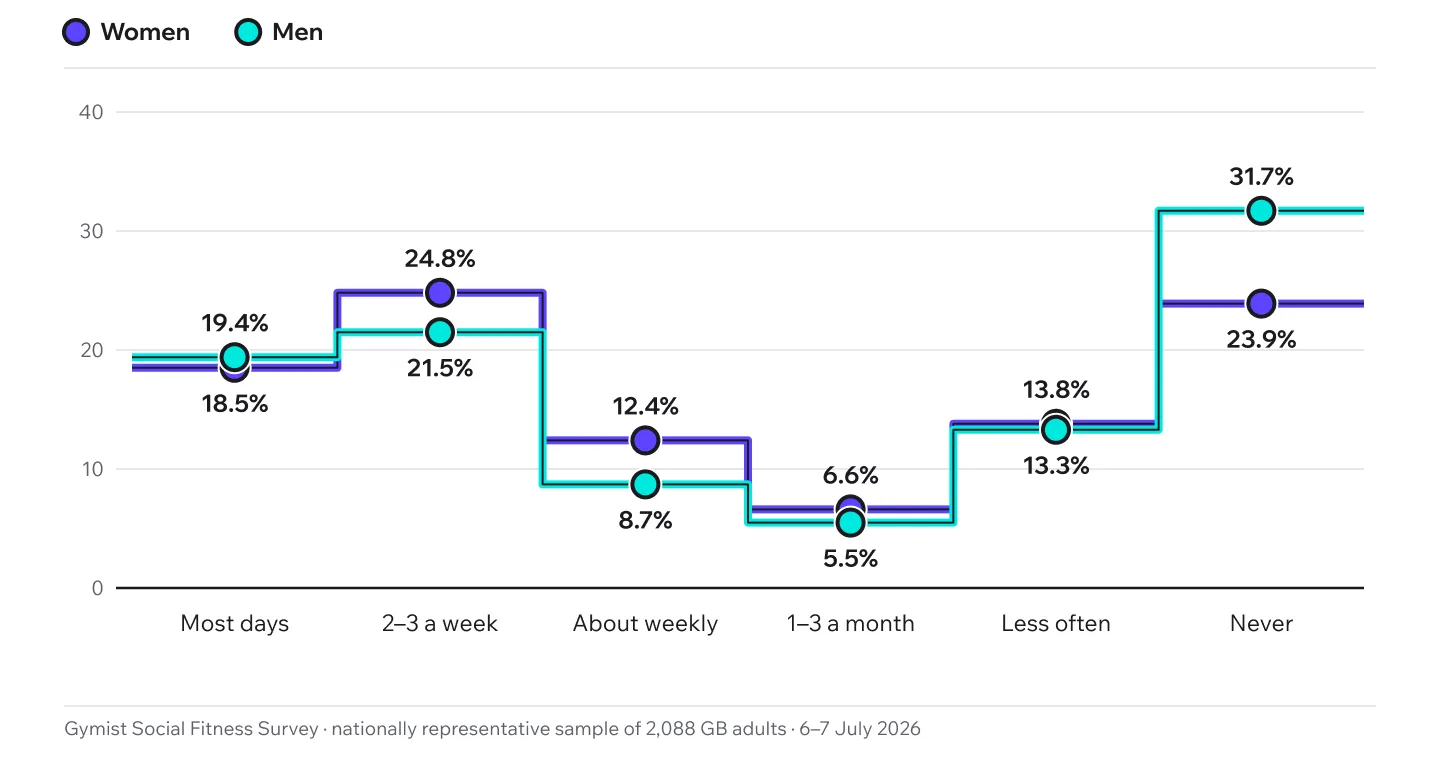
The survey shows that the middle ground of low activity but not inactive is thin. A consistently large group exercises at least two or three times a week, with only a slight decline after 55. However a large group is also at the other extreme of inactivity.
Women are slightly more active than men across most frequencies, with the exception of those who exercise most days. The only group showing a large gender difference is the least active one: 31.7% of men say they never exercise, compared with 23.9% of women.
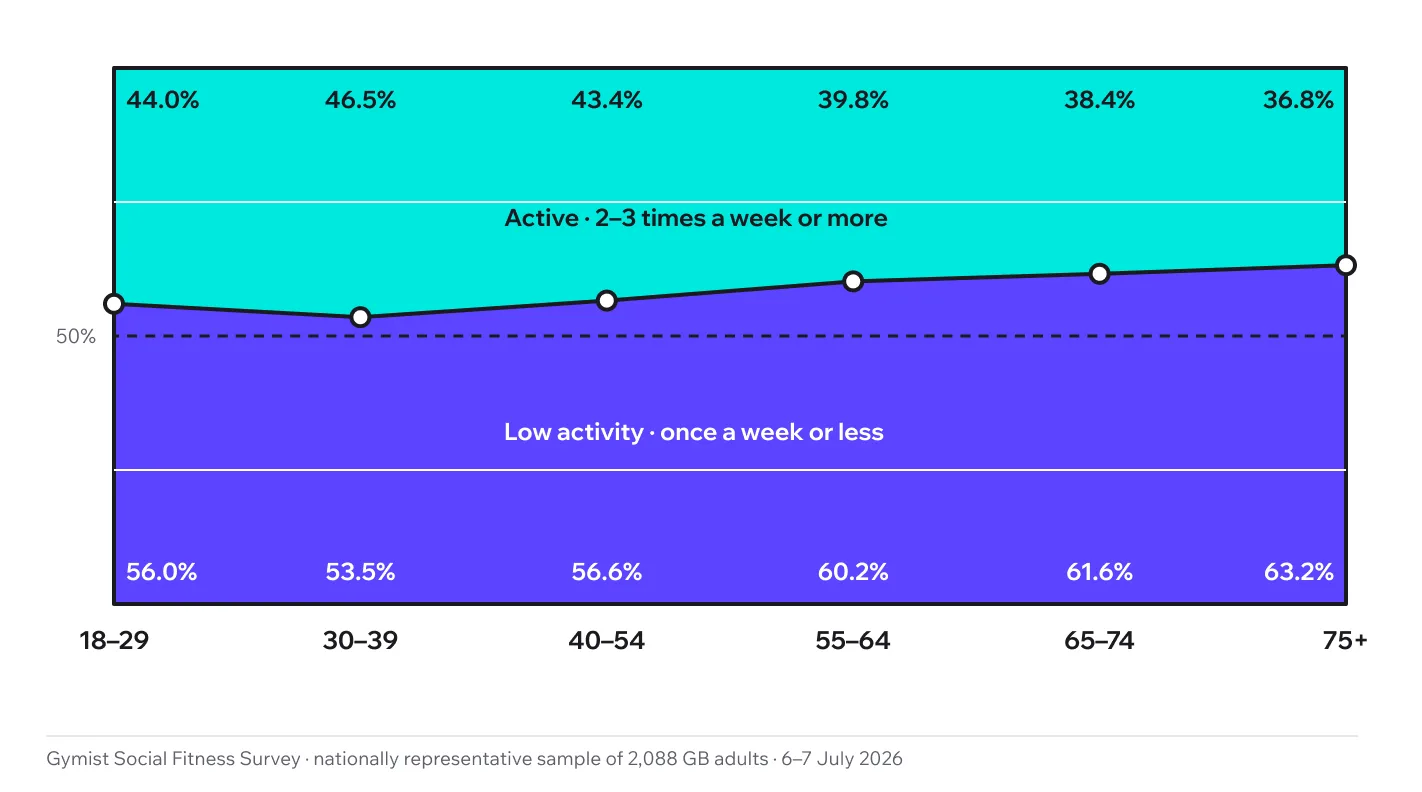
Combined low activity (less than two sessions a week) rises from 56% in the 18-29 group to 62% in the 65-74 group. However inactivity rises from 20% to 36% in these groups.
Gyms are only a fraction of where we're active
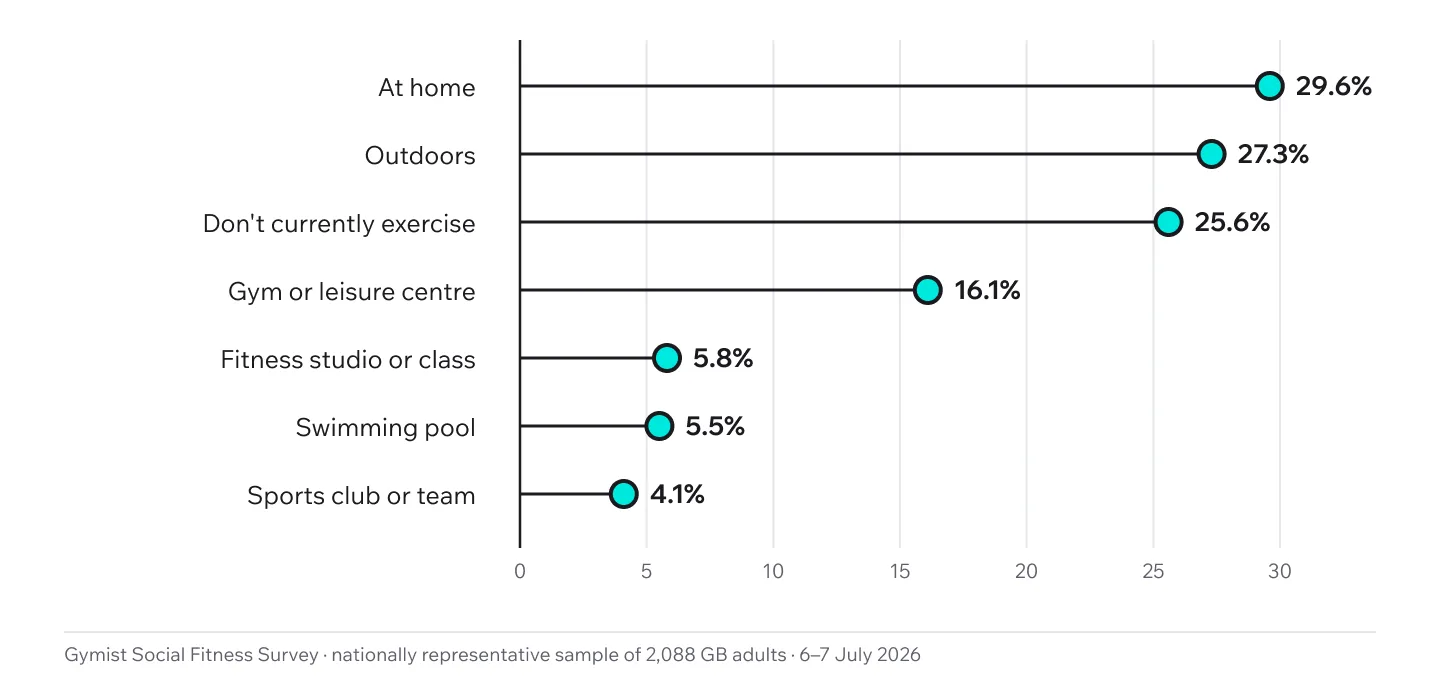
The most common place to exercise in Britain is at home, 29.6%. Outdoors follows at 27.3%. Gyms and leisure centres account for 16.1% — more people told us they don't currently exercise anywhere (25.6%) than told us they use a gym.
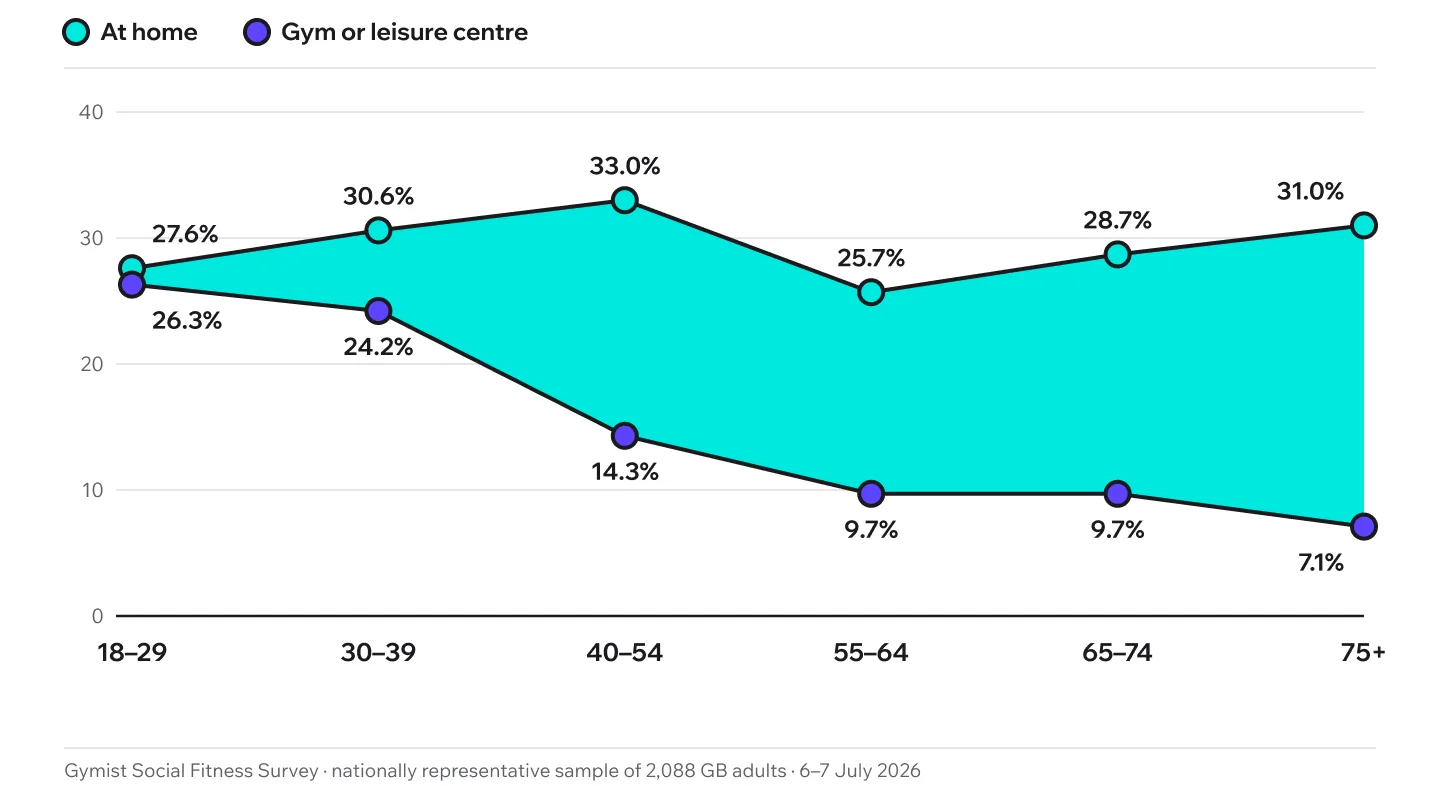
Gyms and leisure centres see a steep drop-off after 39, going from 24.2% to 14.3%, then below 10% from 55. Exercising outdoors follows a similar curve: 29.9% of 18–29s down to 13.4% of over-75s.
Exercising at home does not. It stays relatively flat across every age band — 27.6% of 18–29s, 33.0% at 40–54, 31.0% of over-75s. As activity in gyms and the outdoors decreases, home is what stays. That makes it the obvious route to engaging older age groups, and it raises a question worth asking: what would it take to bring some of that activity back out of the house?
Studios, sports clubs and pools are small in the national picture, and split sharply by gender. 9.1% of women use a studio or class, compared with 2.4% of men — nearly four times the rate. Men are more likely to be in a sports club or team (5.2% v 3.1%). Women are more likely to swim (6.4% v 4.5%).
These are small numbers, and that's a point on its own. They're small partly because provision is uneven and partly because people don't know what's near them. Gymist exists to help people find these spaces and choose the ones that suit them best.
What fitness are we missing out on?
OK, now we have a good picture of how the survey respondents are active and where. It’s time to get into the social elements. We asked whether there were places, areas or activities that they had avoided because of how they felt — even if they'd wanted to try them.
38.6% of people said they have avoided a fitness space or activity.
The free-weights area is the most commonly avoided space, with 18.4% of adults saying they have avoided it. This is followed by group and studio classes (16.9%), exercising in public (15.5%), sports clubs and teams (15.1%), and gyms as a whole (15.1%).
Women reported higher avoidance in every single area we asked about. The gaps are wide and they're consistent:
-
Free-weights area: 23.2% of women, 13.3% of men
-
Exercising in public: 19.7% v 11.1%
-
Sports club or team: 18.8% v 11.2%
-
A gym as a whole: 18.6% v 11.5%
-
Weight machines: 18.2% v 10.3%
This is particularly significant given the updated guidance from UK Chief Medical Officers on muscle-strengthening activity. Yet 27.6% of women and 15.1% of men say they have avoided at least one of the two key strength-training areas we asked about: free weights or weight machines.
It won’t always be this way
The 18–29 bracket reports the strongest avoidance in every single area we asked about. 55.2% of under-30s have avoided at least one fitness space, falling steadily to 20.1% of over-75s.
This is the inverse of the inactivity data. Inactivity rises with age; avoidance falls with it. The youngest adults are the most active cohort and the most likely to have stood outside a room they wanted to enter.
The social reasons for avoiding
We asked those who had avoided somewhere: "Why did you avoid it?" Base: 805 adults who had avoided a fitness space. Multiple answers permitted.
-
55.4% worried about being judged or watched
-
54.3% felt self-conscious about their body or fitness level
-
44.5% felt intimidated
-
41.2% felt like they didn't belong there
-
36.1% didn't know what to do or how to use the equipment
-
25.7% had no one to go with
The knowledge gap is real — 36.1% didn't know what to do or how to use the equipment. But it ranks fifth. Judgement, self-consciousness, intimidation and belonging all rank above it.
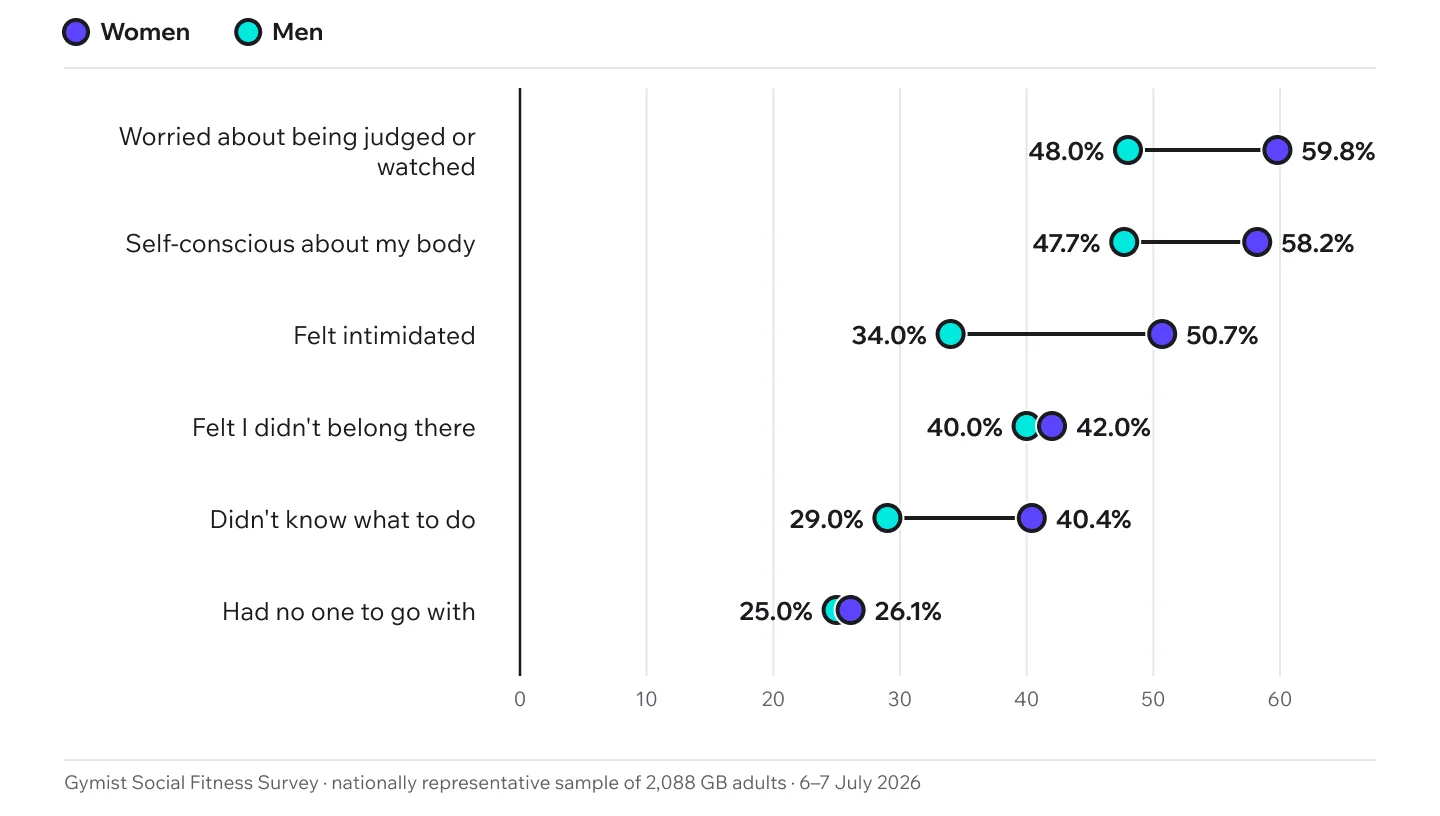
Men who had avoided an area gave their top three reasons as feeling self-conscious about their body or fitness level (48%), worrying about being judged or watched (48%), and feeling like they didn't belong there (40%).
Women gave theirs as worrying about being judged or watched (60%), feeling self-conscious about their body or fitness level (58%), and feeling intimidated (51%).
-------------------------------------------
Fieldwork was carried out by Find Out Now on 6–7 July 2026 among 2,088 GB adults. The final sample was filtered to be nationally representative by age group, gender and UK region. Questions 3 and 4 allowed multiple answers, so those figures total more than 100%. Where a figure describes a subgroup rather than all adults, we've given the base alongside it.
We'll publish the part two full dataset for use with attribution in the week commencing 28 September.